CVPR 2026
CVPR 2026 ✓ Accepted
🏆 First Post-Training Quantization for VLA Systems

QuantVLA Icon QuantVLA

Scale-Calibrated Post-Training Quantization for
Vision-Language-Action Models

1The Ohio State University, 2Indiana University, 3University of Michigan, 4City University of Hong Kong
Equal Contribution
* Corresponding Author: mizhang.1@osu.edu
🏆
First PTQ for VLA
First post-training quantization framework for VLA systems and first to quantize a DiT action head
💾
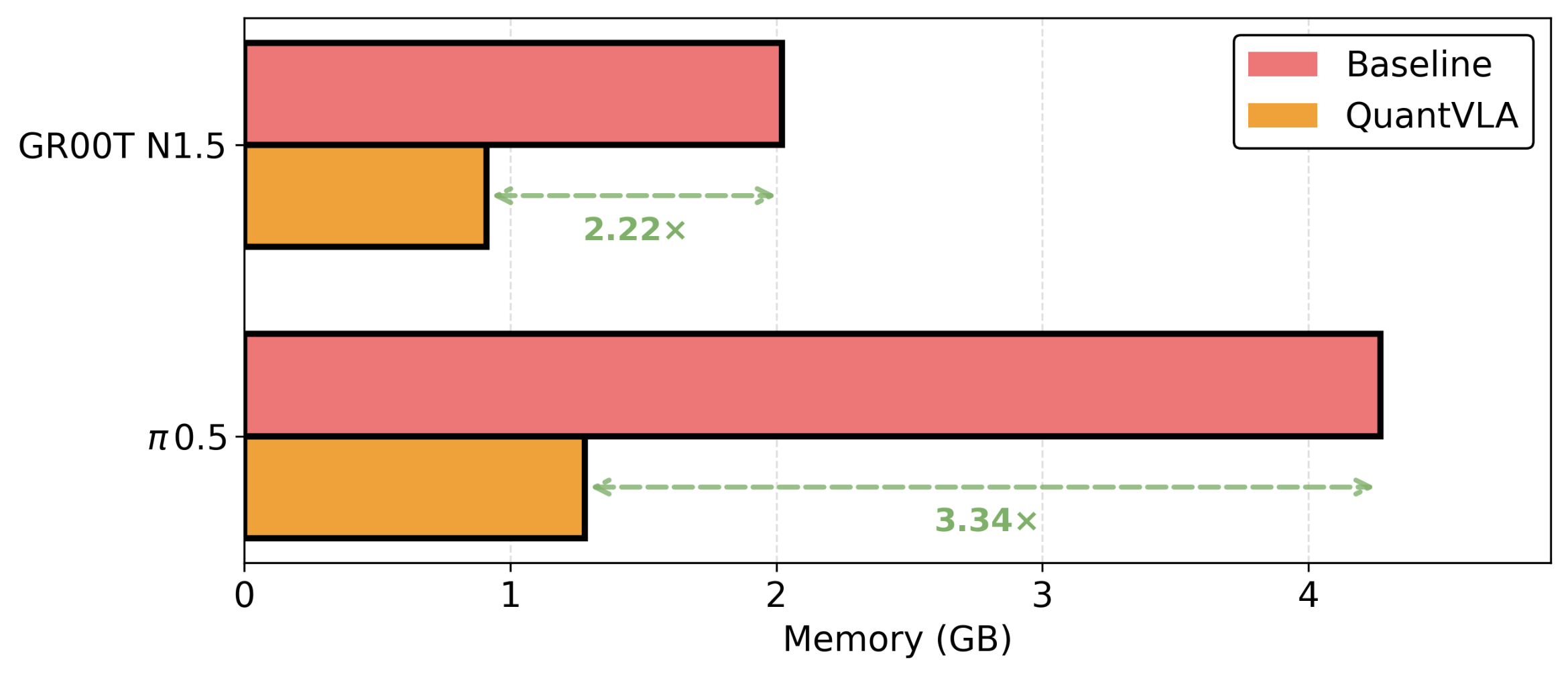
~70% Memory Savings
Significant memory reduction on quantized components with no architecture changes required
Training-Free
Uses only a small unlabeled calibration buffer — no additional training or fine-tuning needed

QuantVLA enables efficient robot learning through quantization.

Abstract

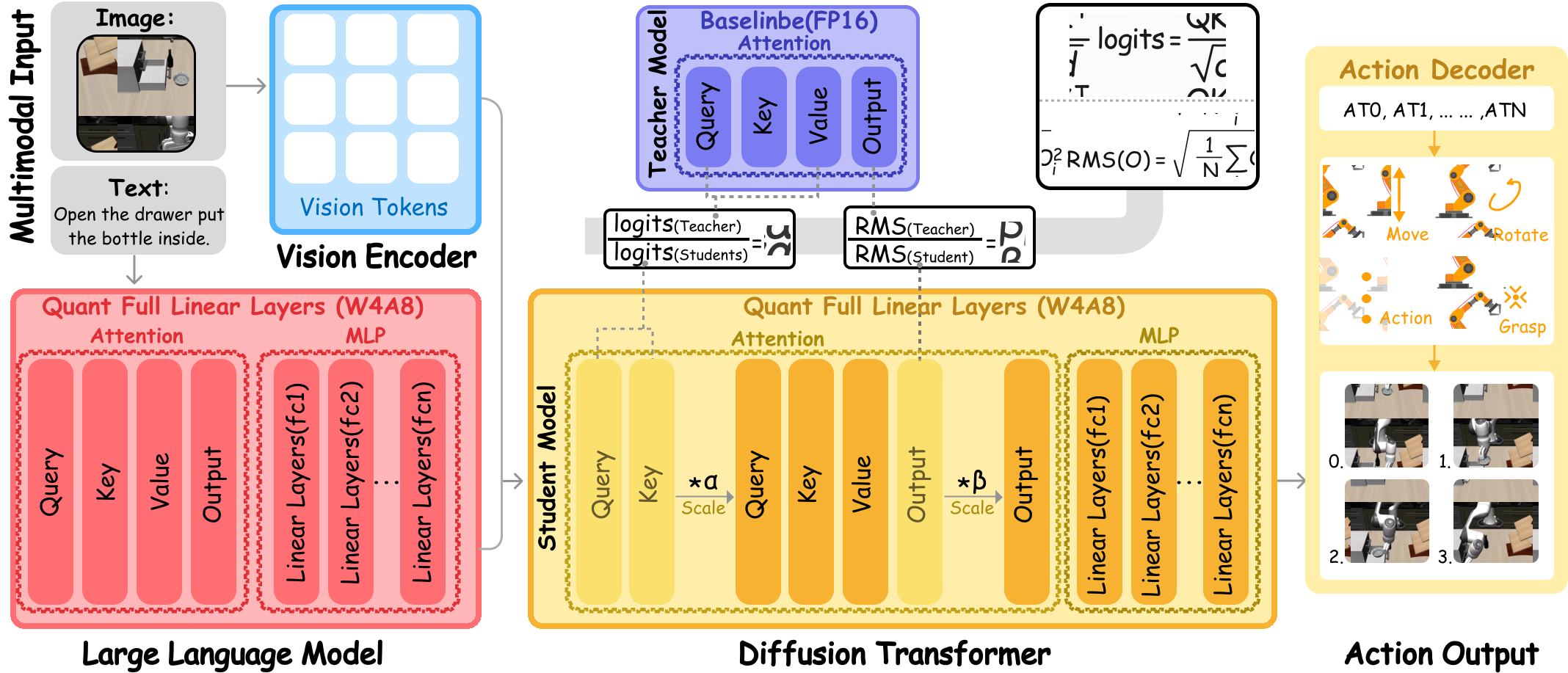
Vision-language-action (VLA) models unify perception, language, and control for embodied agents but face significant challenges in practical deployment due to rapidly increasing compute and memory demands, especially as models scale to longer horizons and larger backbones. To address these bottlenecks, we introduce QuantVLA, a training-free post-training quantization (PTQ) framework that, to our knowledge, is the first PTQ approach for VLA systems and the first to successfully quantize a diffusion transformer (DiT) action head. QuantVLA incorporates three scale-calibrated components: (1) a selective quantization layout that integerizes all linear layers in both the language backbone and the DiT while keeping attention projections in floating point to preserve the original operator schedule; (2) attention temperature matching, a lightweight per-head scaling mechanism that stabilizes attention logits and is folded into the dequantization scales at inference; and (3) output head balancing, a per-layer residual interface calibration that mitigates post-projection energy drift. The framework requires no additional training, uses only a small unlabeled calibration buffer, and supports integer kernels for low-bit weights and activations while leaving the architecture unchanged. Across representative VLA models on LIBERO, QuantVLA exceeds the task success rates of fully-precision baselines, achieves about 70% relative memory savings on the quantized components, providing a practical pathway toward scalable low-bit embodied intelligence under strict compute, memory, and power constraints.

Leaderboard

LIBERO Benchmark — Success Rate (%)

  • All Models
  • π0.5
  • GR00T N1.5
Base Model Method Precision Layer Selection Spatial Object Goal Long Avg
π0.5 Baseline FP16 98.50 99.00 97.50 93.50 97.10
π0.5 +SmoothQuant W8A8 LLM 97.50 98.50 98.00 92.50 96.60
π0.5 +SmoothQuant W8A8 LLM + DiT(MLP) 98.00 99.00 99.00 92.00 97.00
π0.5 +DuQuant W4A8 LLM 98.00 98.50 97.50 92.00 96.50
π0.5 +DuQuant W4A8 LLM + DiT(MLP) 98.00 97.00 94.50 92.00 95.40
π0.5 +QuantVLA W4A8 LLM 98.50 99.00 96.50 96.50 97.60
π0.5 +QuantVLA W4A8 LLM + DiT(MLP) 98.50 98.00 98.00 96.00 97.60
GR00T Baseline FP16 92.00 92.00 86.00 76.00 86.50
GR00T +DuQuant W4A8 LLM 86.00 92.00 80.00 80.00 84.50
GR00T +DuQuant W4A8 LLM + DiT 66.00 70.00 68.00 76.00 70.00
GR00T +QuantVLA W4A8 LLM 96.00 94.00 92.00 66.00 87.00
GR00T +QuantVLA W4A8 LLM + DiT 96.00 92.00 90.00 74.00 88.00

Method

Qualitative and quantitative results demonstrating the efficiency and accuracy of QuantVLA will be presented here. The method relies on post-training quantization to reduce model size while maintaining VLA capabilities.

Method Overview

Memory Efficiency

Memory Comparison: Baseline vs QuantVLA

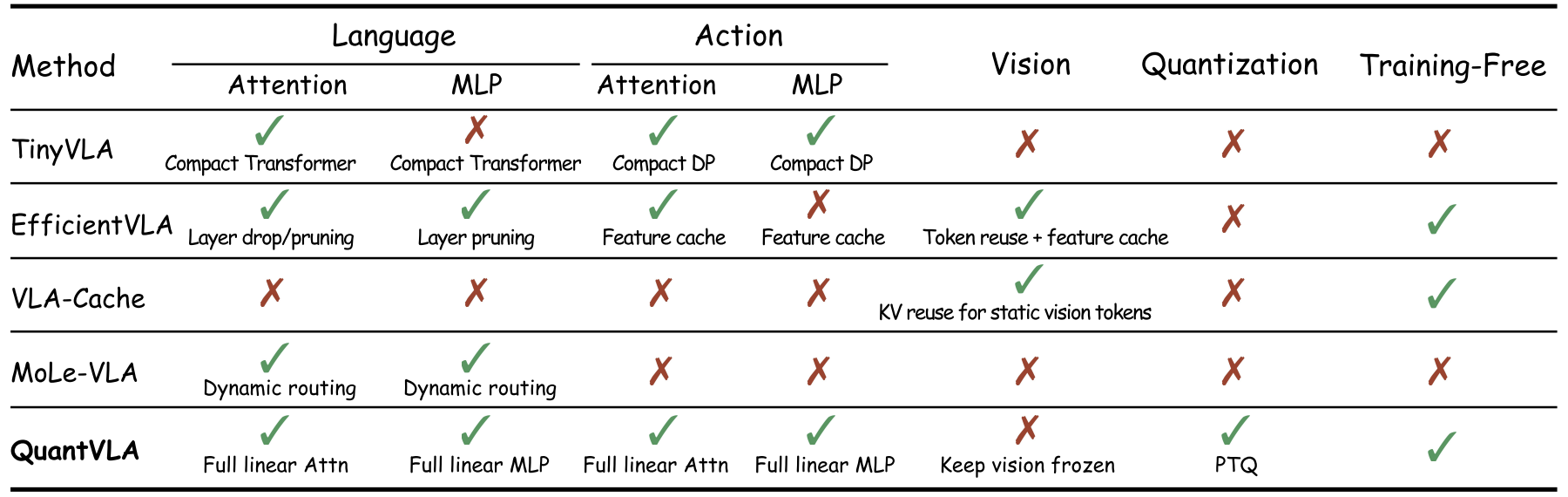
Comparison of VLA Efficiency Paradigms

Efficiency Comparison

Conclusion

We present QuantVLA, the first PTQ framework for VLA models that surpasses full precision baselines without any additional training. Using a selective layout, it integerizes the language backbone and the feedforward blocks of the diffusion transformer while attention projections remain in floating point. Two lightweight calibration scalars align the attention temperature and restore the output energy, thereby stabilizing low-bit inference. As a result, QuantVLA reduces memory usage and improves accuracy. Overall, QuantVLA is training-free, preserves the original architecture, and is robust across modalities, offering a practical path to low-bit deployment and laying the groundwork for future advances, lower power budgets, and reliable long-horizon generation.

BibTeX

@article{quantvla2026, author = {Anonymous}, title = {QuantVLA: Quantizing Vision-Language-Action Models}, journal = {CVPR Submission}, year = {2026}, }